
Know Your Chakras, Mudras & Meditations
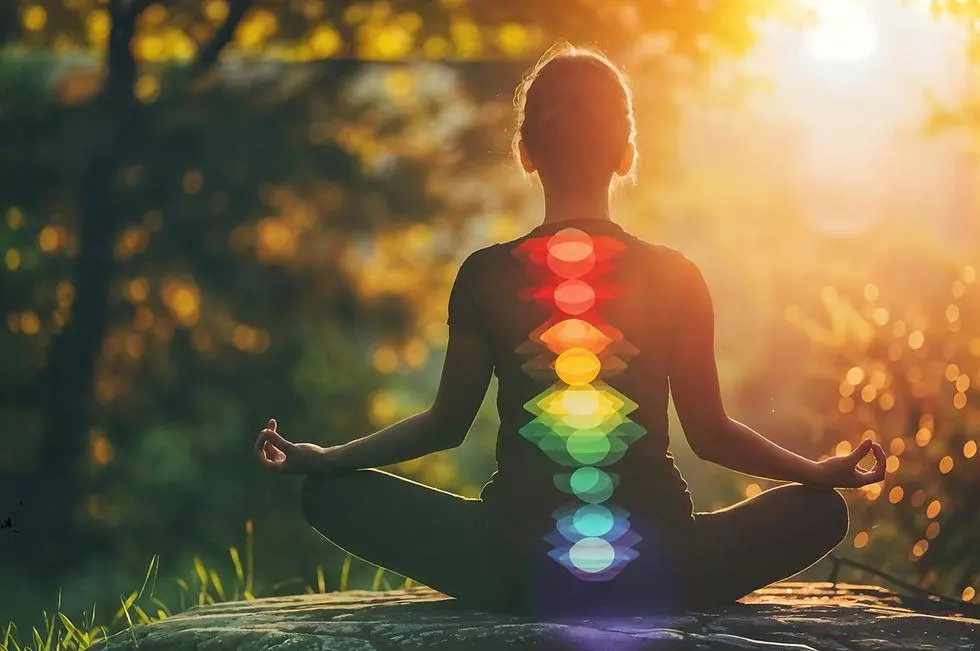
Explore the seven chakras, the meaning of traditional hand mudras, and simple meditation practices to cultivate awareness, balance, and inner peace.
By Komala Thimmappa
Founder, Beyond AI Space | Certified Yoga Teacher
Have you ever wondered why certain meditation practices leave you feeling calmer, more centered, or more connected to yourself?
For thousands of years, yoga and contemplative traditions have explored the relationship between the body, mind, breath, and awareness.
Among these traditions are three fascinating practices: chakras, mudras, and meditation.
Chakras offer a symbolic framework for exploring different aspects of human experience. Mudras use intentional hand positions as part of contemplative practice. Meditation helps us develop attention, awareness, and a different relationship with our thoughts.
Although their origins and purposes differ, these practices can be explored together as part of a mindful daily routine.
At Beyond AI Space, we believe that understanding traditional wisdom while remaining open to scientific knowledge can help us develop a more thoughtful approach to conscious living.
1. What Are Chakras?
The word chakra comes from Sanskrit and is commonly translated as “wheel.”
In several Indian spiritual and yogic traditions, chakras are described as centers within a subtle-body framework.
Different historical traditions describe different numbers and arrangements of chakras. Today, the seven-chakra model is one of the most widely recognized systems in modern yoga and wellness education.
Chakras are traditionally associated with qualities such as stability, creativity, confidence, compassion, communication, insight, and spiritual connection.
It is important to understand that chakras are spiritual and symbolic concepts, not scientifically established anatomical organs or measurable energy centers.
For meditation, however, the chakra framework can provide meaningful themes for self-reflection.
2. Understanding the Seven Chakras
1. Root Chakra — Muladhara
Traditional location: Base of the spine
Associated color: Red
Traditional themes: Grounding, stability, security, and belonging
The Root Chakra symbolizes our sense of connection to everyday life and the world around us.
Reflection: What helps me feel stable and supported?
Suggested practice: Sit comfortably, feel the contact between your body and the chair or floor, and notice your breathing.
Affirmation: “I am grounded in the present moment.”
2. Sacral Chakra — Svadhisthana
Traditional location: Lower abdomen
Associated color: Orange
Traditional themes: Creativity, emotions, enjoyment, and adaptability
The Sacral Chakra is often used as a symbol for emotional expression and creative living.
Reflection: Where can I allow more creativity and enjoyment into my life?
Suggested practice: Take a few minutes to notice your emotions without judging or immediately reacting to them.
Affirmation: “I welcome creativity and change.”
3. Solar Plexus Chakra — Manipura
Traditional location: Upper abdomen
Associated color: Yellow
Traditional themes: Confidence, personal agency, and determination
This chakra is commonly associated with our ability to make choices and take purposeful action.
Reflection: What is one meaningful action I can take today?
Suggested practice: Sit upright, breathe naturally, and reflect on a goal that matters to you.
Affirmation: “I trust my ability to make thoughtful choices.”
4. Heart Chakra — Anahata
Traditional location: Center of the chest
Associated color: Green
Traditional themes: Love, compassion, kindness, and connection
The Heart Chakra represents compassion toward ourselves and others.
Reflection: How can I show kindness today?
Suggested practice: Try a brief loving-kindness meditation, silently offering kind wishes to yourself and someone else.
Affirmation: “I choose compassion for myself and others.”
5. Throat Chakra — Vishuddha
Traditional location: Throat
Associated color: Blue
Traditional themes: Communication, expression, and authenticity
The Throat Chakra symbolizes thoughtful communication and the ability to express ourselves.
Reflection: Am I communicating what matters to me clearly and respectfully?
Suggested practice: Spend a minute listening carefully to the sounds around you, without labeling them as good or bad.
Affirmation: “I express myself with clarity and kindness.”
6. Third Eye Chakra — Ajna
Traditional location: Between the eyebrows
Associated color: Indigo
Traditional themes: Insight, intuition, and discernment
The Third Eye Chakra is commonly used as a symbol for inner observation and perspective.
Reflection: What can I observe before drawing a conclusion?
Suggested practice: Close your eyes if comfortable and notice thoughts as they come and go.
Affirmation: “I make room for awareness and understanding.”
7. Crown Chakra — Sahasrara
Traditional location: Top of the head
Associated color: Violet or white
Traditional themes: Meaning, spirituality, and connection beyond the individual self
The Crown Chakra symbolizes contemplation of purpose and a wider sense of connection.
Reflection: What gives my life meaning?
Suggested practice: Sit quietly and reflect on something for which you feel gratitude.
Affirmation: “I remain open to learning and a deeper sense of purpose.”
Note: Colors, locations, and interpretations can vary among historical and contemporary traditions.
3. What Are Mudras?
The Sanskrit word mudra can refer to a gesture, seal, or symbolic position.
In yoga and meditation, mudras often involve specific hand positions, although traditional systems also include other forms of gesture and posture.
Mudras have cultural, spiritual, and contemplative significance.
Many practitioners use them to create a sense of ritual, support attention, or connect with a particular intention.
However, there is currently insufficient high-quality scientific evidence to conclude that individual finger positions independently treat diseases, regulate hormones, or directly alter the function of specific organs.
Mudras can still be appreciated as meaningful elements of meditation practice.
4. Five Traditional Hand Mudras to Explore
Gyan Mudra — Gesture of Knowledge
How to practice: Gently touch the tip of the index finger to the thumb while allowing the remaining fingers to relax.
Traditional association: Knowledge, awareness, and concentration.
Meditation idea: Use this gesture while focusing on your natural breathing for two minutes.
Anjali Mudra — Gesture of Respect
How to practice: Bring your palms together gently in front of your chest.
Traditional association: Respect, gratitude, and connection.
Meditation idea: Reflect on one person or experience you appreciate.
Dhyana Mudra — Gesture of Meditation
How to practice: Rest both hands comfortably in your lap, with one palm resting on the other and the thumbs lightly touching if comfortable.
Traditional association: Meditation and contemplative stillness.
Meditation idea: Notice your breathing without trying to change it.
Prana Mudra — Gesture Associated with Vitality
How to practice: In a common modern variation, gently bring the tips of the ring finger and little finger toward the thumb.
Traditional association: Vitality and life energy.
Meditation idea: Reflect on activities that leave you feeling rested and engaged.
Apana Mudra — A Traditional Yogic Gesture
How to practice: In a common modern variation, touch the tips of the middle and ring fingers to the thumb.
Traditional association: Release and letting go.
Meditation idea: Notice one thought you are willing to hold more lightly.
These gestures should feel relaxed. Do not strain the fingers or continue a position that causes discomfort.
5. Meditation: What Happens When We Practice?
Meditation is a broad term covering practices that train attention, awareness, and our relationship with mental experiences.
Some approaches focus on breathing. Others involve a repeated phrase, bodily sensations, compassion, or open awareness.
During meditation, thoughts do not necessarily disappear.
Instead, practitioners learn to notice when attention has wandered and gently return to the chosen focus.
This repeated process can be part of developing attentional awareness.
Modern research has investigated meditation in relation to psychological stress, anxiety, depressive symptoms, sleep, and other outcomes.
The findings are encouraging for some applications, but they vary according to the technique, population, study design, and outcome measured.
6. What Does Scientific Research Say About Meditation?
A major systematic review published in JAMA Internal Medicine in 2014 evaluated 47 trials involving 3,515 participants.
Researchers found moderate evidence that mindfulness meditation programs produced small to moderate improvements in anxiety, depression, and pain.
The review also emphasized that stronger studies were needed for several other outcomes.
The U.S. National Institutes of Health reports that meditation and mindfulness practices may help with certain stress-related and mental health outcomes, although the evidence is not equally strong for every claimed benefit.
What about chakra meditation and mudras specifically?
The evidence for general mindfulness meditation should not be used as proof that chakras are physically measurable or that particular mudras produce specific medical effects.
These are different claims requiring different types of evidence.
Traditional chakra and mudra practices can be explored for their symbolic, cultural, and personal significance without presenting them as proven medical treatments.
7. A Simple 10-Minute Chakra-Inspired Meditation
This beginner-friendly practice uses the seven chakras as themes for reflection rather than attempting to diagnose or medically treat an “energy imbalance.”
Minute 1: Become Comfortable
Sit in a stable chair or on a cushion. Allow your hands to rest comfortably.
Notice your surroundings and breathe naturally.
Minute 2: Grounding
Reflect on the Root Chakra theme of stability.
Feel your feet or body supported by the floor or chair.
Minute 3: Creativity
Reflect on the Sacral Chakra theme of creativity.
Think of one activity that brings you enjoyment.
Minute 4: Confidence
Reflect on the Solar Plexus Chakra theme of personal agency.
Consider one manageable step toward an important goal.
Minute 5: Compassion
Reflect on the Heart Chakra theme of kindness.
Offer yourself a gentle, encouraging thought.
Minute 6: Communication
Reflect on the Throat Chakra theme of expression.
Think about one conversation you would like to approach with care.
Minute 7: Awareness
Reflect on the Third Eye Chakra theme of insight.
Notice your thoughts without needing to follow each one.
Minute 8: Meaning
Reflect on the Crown Chakra theme of purpose.
Consider something meaningful in your life.
Minute 9: Quiet Awareness
Release the themes and simply notice your natural breathing.
Minute 10: Return to the Present
Open your eyes if they were closed. Notice your surroundings and take your time returning to your day.
You can use Gyan Mudra, Dhyana Mudra, or simply rest your hands naturally throughout the practice.
8. How to Build a Daily Meditation Habit
You do not need an elaborate spiritual routine to begin.
Start with three to five minutes at a time.
Choose a comfortable place where interruptions are limited.
Experiment with breathing awareness, gentle sound awareness, or a simple reflective theme.
Rather than judging the session by how quiet your mind becomes, notice whether you are learning to return your attention with patience.
Consistency may be more useful than trying to achieve a perfect meditation experience.
9. Are Chakra Meditation and Mudras Safe for Everyone?
Gentle hand gestures are usually low-intensity activities, but meditation is not entirely risk-free.
Some people report uncomfortable emotional experiences, increased anxiety, or distress during meditation.
If a practice makes you feel overwhelmed, stop, open your eyes, and reconnect with your surroundings.
People with a history of trauma or significant mental health symptoms may benefit from an appropriately trained instructor and professional guidance.
Meditation should complement, not replace, appropriate medical or mental health care.
10. The Beyond AI Space Philosophy: Awareness, Alignment, and Conscious Living
At Beyond AI Space, we explore the connection between traditional wisdom, mindful living, nature, and modern understanding.
Chakras can invite us to reflect on important dimensions of life.
Mudras can add intention and symbolism to a contemplative practice.
Meditation can help us practice attention and awareness.
Together, they offer an opportunity to slow down and examine how we relate to ourselves and the world around us.
We do not have to master every technique or adopt every spiritual belief to appreciate the value of mindful reflection.
Conscious living begins when we become more aware of how we think, feel, act, and connect with the world around us.
Explore Conscious Living with Beyond AI Space
Discover our educational experiences in meditation, mindfulness, nature-inspired wellness, and personal transformation.
Visit Beyond AI Space to explore our programs.
Frequently Asked Questions
What are the seven chakras?
The seven chakras are a commonly used framework in modern yoga traditions, symbolically associated with grounding, creativity, confidence, compassion, communication, insight, and spiritual connection.
Are chakras scientifically proven?
Chakras are concepts within traditional spiritual systems. They have not been established as measurable anatomical structures or physiological energy centers.
What is the difference between mudras and meditation?
Mudras are symbolic gestures or positions, while meditation refers to practices that develop attention and awareness. Mudras may be incorporated into meditation.
Which mudra is best for beginners?
Gyan Mudra, Anjali Mudra, and Dhyana Mudra are simple gestures that many beginners find comfortable. There is no strong scientific evidence that one is medically superior to another.
Can chakra meditation reduce stress?
Some people find chakra-themed reflection calming. Research supports certain benefits of mindfulness meditation, but this does not establish specific therapeutic effects from chakra visualization itself.
How long should beginners meditate?
Three to five minutes is a reasonable starting point. The duration can be adjusted according to comfort and individual needs.
Do I need to believe in chakras to practice meditation?
No. You can practice breathing awareness, mindfulness, and other secular forms of meditation without adopting a particular spiritual framework.
Educational disclaimer: This article is intended for general wellness and cultural education. Chakra and mudra associations are traditional interpretations, not medical diagnoses or scientifically established treatments.
Contact Us
Recent Posts

Food as Medicine: Ayurveda & Herbs for Healing
Ancient wisdom, everyday nourishment, and what modern science tells us about the healing potential of food. By Komala ThimmappaFounder, Beyond AI Space What if one
Understanding the Body: Anatomy & Yoga Stretches
Discover how your muscles, joints, spine, and breath work together—and how gentle yoga stretches can help you move with greater awareness. By Komala ThimmappaFounder, Beyond
Know Your Chakras, Mudras & Meditations
Explore the seven chakras, the meaning of traditional hand mudras, and simple meditation practices to cultivate awareness, balance, and inner peace. By Komala ThimmappaFounder, Beyond
The Human Aura: Understanding Energy, Emotions & the Science of the Body
Exploring ancient beliefs, the mystery of human energy, and what modern science reveals about the invisible processes within us. By Komala ThimmappaFounder, Beyond AI Space

Look Younger, Naturally: Skin Care, Hair Care, Herbal Oils & Nutrition for Healthy Aging
Discover how traditional beauty rituals, nourishing foods, botanical oils, and simple everyday habits can support healthy-looking skin and hair at every age. By Komala ThimmappaFounder,

Situational Depression & Anxiety: Understanding the Causes and Supporting Recovery Naturally
How stressful life events affect our emotional well-being—and how nature, movement, mindfulness, healthy routines, and human connection can help us move toward recovery. By Komala