Ancient wisdom, everyday nourishment, and what modern science tells us about the healing potential of food.
By Komala Thimmappa
Founder, Beyond AI Space
What if one of the simplest ways to care for our well-being begins in our own kitchen?
Long before modern nutritional science began studying antioxidants, plant compounds, and the relationship between diet and disease, traditional cultures understood that what we eat can influence how we feel.
Ayurveda, India’s ancient system of health and well-being, has long emphasized the connection between food, lifestyle, digestion, and individual balance.
Today, scientific research is exploring many of the ingredients used in traditional cooking. Some have demonstrated promising health effects, while others still require stronger evidence.
At Beyond AI Space, we believe traditional wisdom and modern knowledge can complement one another—helping us make more conscious choices about everyday living.
1. What Does “Food as Medicine” Really Mean?
Food provides more than energy. It supplies proteins, healthy fats, carbohydrates, vitamins, minerals, fiber, and plant compounds that help our bodies function.
A nourishing dietary pattern can support cardiovascular health, digestive function, metabolic health, and general well-being.
The idea of food as medicine does not mean that a particular spice can cure a disease. Rather, it recognizes that our daily eating habits are an important part of long-term health.
A simple home-cooked meal containing vegetables, lentils, whole grains, and herbs can be both satisfying and nutritious.
The most powerful changes often begin with what we do consistently, not occasionally.
2. Understanding Ayurveda’s Approach to Food
In Ayurveda, food is traditionally viewed through qualities such as warmth, heaviness, lightness, taste, and seasonality.
Ayurvedic philosophy also describes three doshas:
Vata: Associated traditionally with movement and the elements of air and space.
Pitta: Associated with transformation, heat, and digestion.
Kapha: Associated with structure, stability, and nourishment.
These are traditional Ayurvedic concepts, not scientifically established medical diagnoses or biological categories.
Ayurvedic eating practices often encourage freshly prepared meals, attention to hunger, seasonal ingredients, and mindful eating.
Some of these habits align with general principles of healthy nutrition, although that does not validate every traditional explanation or treatment.
3. Five Herbs and Spices Worth Knowing
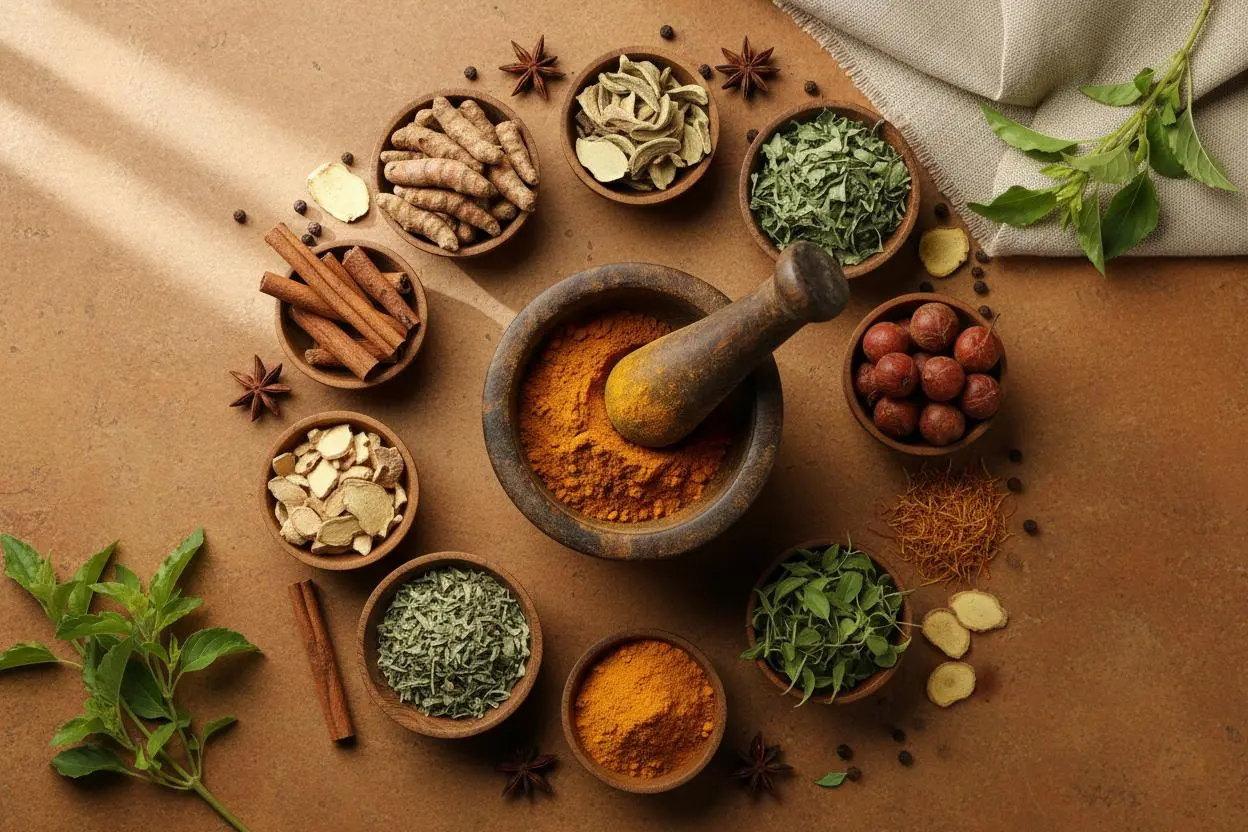
Turmeric: The Golden Spice
Turmeric (Curcuma longa) has been used in Indian cooking for centuries.
Its distinctive golden color comes partly from curcumin, a plant compound studied for its potential biological effects.
Research involving concentrated turmeric or curcumin extracts suggests possible benefits for some people experiencing knee osteoarthritis symptoms. However, results vary, and stronger research is needed.
Importantly, clinical studies of concentrated extracts cannot automatically be applied to the small amounts of turmeric used in ordinary meals.
Everyday kitchen idea: Add turmeric to lentil soups, roasted vegetables, curries, or warm milk.
Ginger: A Traditional Digestive Favorite
Ginger (Zingiber officinale) is a familiar ingredient in traditional Asian cooking and herbal preparations.
Among its many proposed uses, relief from certain types of nausea has some of the better clinical evidence, particularly pregnancy-related nausea.
Other proposed benefits remain less certain.
Everyday kitchen idea: Add freshly grated ginger to vegetable dishes, soups, or a warm ginger infusion.
Cinnamon: Flavor, Warmth, and Research
Cinnamon has been used for centuries in both cooking and traditional wellness practices.
Scientists have investigated whether cinnamon supplements influence blood sugar levels. Findings remain inconsistent, and cinnamon has not been established as a treatment for diabetes.
Everyday kitchen idea: Sprinkle a small amount over oatmeal, fruit, or unsweetened yogurt.
Cumin: A Flavorful Culinary Tradition
Cumin is a staple of many Indian, Middle Eastern, and other traditional cuisines.
It adds distinctive aroma and flavor to lentils, vegetable dishes, and grain-based meals.
Although cumin contains plant compounds of scientific interest, there is not enough reliable human evidence to claim that ordinary culinary use treats digestive or metabolic diseases.
Everyday kitchen idea: Toast cumin seeds lightly and add them to lentil soup or sautéed vegetables.
Tulsi: A Plant with Cultural Significance
Tulsi, also known as holy basil (Ocimum tenuiflorum), holds an important place in Indian cultural and Ayurvedic traditions.
It is commonly enjoyed as an herbal infusion and has been investigated for potential effects on stress and other health outcomes.
However, clinical evidence remains limited, and tulsi should not be presented as a proven treatment for anxiety, hormonal disorders, or other medical conditions.
Everyday kitchen idea: Enjoy a mild tulsi infusion made from food-grade leaves, while checking for medication interactions and pregnancy-related precautions before using concentrated preparations.
4. What Modern Research Actually Shows
Modern science is particularly interested in the effects of dietary patterns, plant compounds, and certain herbal extracts.
For example:
Turmeric and joint health: A 2022 systematic review and meta-analysis examined 29 randomized controlled trials involving 2,396 participants with different types of arthritis. The researchers found promising effects on some pain and inflammation measures, but emphasized limitations in study quality.
Ginger and nausea: A comprehensive review of 109 randomized controlled trials found relatively consistent support for some ginger-related outcomes, particularly nausea and vomiting, while noting uncertainty in other areas.
Cinnamon and blood sugar: Studies have produced mixed results. Some trials suggest possible improvements in certain blood glucose measures, but there is insufficient reliable evidence to recommend cinnamon as a diabetes treatment.
These studies illustrate an important principle: an herb may have a long history of traditional use and still require careful scientific evaluation.
Research on supplements also differs from research on food. A concentrated extract may contain much larger amounts of an active compound than an ordinary meal.
5. Why the Whole Meal Matters More Than One Herb
Instead of searching for one miracle ingredient, consider the entire meal.
A balanced plate might include:
Vegetables for fiber and micronutrients
Lentils or beans for plant protein and fiber
Whole grains for energy and additional nutrients
Nuts, seeds, or other sources of healthy fats
Herbs and spices for flavor and dietary variety
Traditional Indian dishes such as dal with vegetables and whole grains can fit naturally into a balanced eating pattern.
The goal is not to follow a rigid formula. It is to develop nourishing habits that work for your individual needs.
6. Three Simple Ways to Bring Ayurveda-Inspired Eating into Daily Life
Start the Day with Awareness
Before reaching for your phone or rushing into your routine, take a moment to notice how you feel.
Drink water if you are thirsty, consider your appetite, and choose a nourishing breakfast.
Make One Mindful Meal a Day
Sit down without unnecessary distractions.
Notice the aroma, flavor, texture, and satisfaction of your meal.
Mindful eating can help you become more aware of your eating experience, although it should not be presented as a cure for digestive conditions.
Add Variety Through Herbs and Seasonal Produce
Experiment with fresh vegetables, lentils, ginger, turmeric, cumin, and other culinary herbs.
Seasonal foods can bring variety and pleasure to your meals without requiring complicated wellness routines.
7. A Simple Ayurvedic-Inspired Recipe: Golden Vegetable Dal
Ingredients
½ cup red lentils
2 cups water, plus more as needed
½ teaspoon turmeric
½ teaspoon cumin seeds
1 teaspoon freshly grated ginger
1 cup chopped vegetables
1 teaspoon olive oil or another cooking oil
Salt to taste
Fresh cilantro and lemon, optional
Preparation
Rinse the lentils and place them in a saucepan with water.
Add turmeric, ginger, and chopped vegetables.
Simmer until the lentils and vegetables are tender.
In a small pan, gently heat the oil and cumin seeds until fragrant.
Stir the cumin mixture into the cooked lentils.
Add salt to taste and finish with cilantro or lemon if desired.
Serve with brown rice or another whole grain.
This meal offers plant protein, fiber, vegetables, and familiar traditional flavors.
8. Are Ayurvedic Herbs Always Safe?
Natural does not automatically mean safe.
Herbal supplements may interact with prescription medications, affect pregnancy, or cause adverse reactions. Some Ayurvedic products have also been found to contain potentially toxic amounts of heavy metals.
Highly concentrated turmeric or curcumin supplements, particularly certain enhanced-absorption formulations, have been associated with liver injury.
People who are pregnant, breastfeeding, managing a medical condition, or taking medication should discuss herbal supplements with a qualified healthcare professional.
Food-based wellness practices can complement appropriate medical care, but should not replace prescribed treatment.
9. The Beyond AI Space Philosophy: Nourish, Connect, and Live Consciously
At Beyond AI Space, we explore the connection between ancient wisdom, nature, modern knowledge, and conscious living.
Food is one part of that connection.
When we choose nourishing ingredients, prepare meals with attention, and become more aware of our everyday habits, we create opportunities to care for ourselves.
Well-being is not about finding one perfect herb or following every traditional practice. It is about developing a thoughtful relationship with our bodies, our environment, and the choices we make each day.
Nature offers nourishment. Wisdom helps us appreciate it. Science helps us understand it.
Explore More with Beyond AI Space
Discover programs and educational experiences in nature therapy, mindfulness, conscious living, and holistic well-being.
Visit Beyond AI Space to learn more.
Frequently Asked Questions
What is food as medicine in Ayurveda?
It is the traditional view that food choices, preparation methods, and eating habits influence personal balance and well-being. Modern nutritional science independently supports the importance of healthy dietary patterns.
Which Ayurvedic herb has the strongest scientific evidence?
Evidence depends on the specific health outcome. Ginger has relatively encouraging evidence for some forms of nausea, while turmeric or curcumin extracts have shown promising results in certain osteoarthritis studies. Neither should be described as a universal cure.
Can turmeric reduce inflammation?
Curcumin has been investigated for anti-inflammatory effects, but evidence for treating specific medical conditions remains incomplete. Results from concentrated supplements should not be equated with ordinary culinary turmeric.
Is Ayurveda scientifically proven?
Ayurveda is a broad traditional medical system. Some individual practices and preparations have been studied, but many claims lack high-quality clinical evidence. Each intervention needs to be evaluated separately.
Can Ayurvedic herbs replace medication?
No. Herbal products should not replace prescribed medication without medical guidance.
Educational disclaimer: This article is intended for general wellness education and does not provide medical diagnosis or treatment advice.
Research and Further Reading
National Institutes of Health, NCCIH. Ayurvedic Medicine: In Depth.
National Institutes of Health, NCCIH. Turmeric: Usefulness and Safety.
National Institutes of Health, NCCIH. Ginger: Usefulness and Safety.
Zeng et al. (2022). Efficacy and Safety of Curcumin and Curcuma longa Extract in the Treatment of Arthritis: A Systematic Review and Meta-Analysis.
Ginger on Human Health: A Comprehensive Systematic Review of 109 Randomized Controlled Trials.
National Institutes of Health, NCCIH. Cinnamon: Usefulness and Safety.
Cochrane. Cinnamon for Diabetes Mellitus.