Nature Therapy: How Reconnecting with Nature Supports Mind, Body & Well-Being
Beyond AI Space | Research & Insights | Nature & Conscious Living
Discover what scientific research reveals about spending time in nature, and how simple daily practices can help you live with greater awareness, balance, and connection.
Modern life keeps us constantly connected to technology, yet often disconnected from the natural world. Between demanding schedules, digital distractions, and everyday responsibilities, many people spend much of their time indoors.
But what happens when we reconnect with nature?
Research suggests that spending time in natural environments can support psychological well-being, reduce certain measures of stress, and provide opportunities for physical activity, reflection, and restoration.
At Beyond AI Space, we believe that reconnecting with nature does not require expensive retreats or dramatic lifestyle changes. It can begin with simple, conscious moments woven into everyday life.
What scientific research says about nature therapy
1. Nature may help reduce stress and support relaxation
The Japanese practice of Shinrin-yoku, often called forest bathing, encourages people to experience a forest slowly and attentively through their senses.
In a study published in Environmental Health and Preventive Medicine, researchers compared participants’ physiological responses in forest and urban environments across 24 forests in Japan.
They observed lower average cortisol concentrations, pulse rates, and blood pressure during forest exposure compared with urban exposure. These findings suggest that forest environments may support short-term physiological relaxation, although they do not establish that forest bathing treats medical conditions.
Springer Nature Link
Try this: Visit a nearby park or wooded area. Walk slowly, notice the trees and natural sounds, and spend a few moments observing your surroundings without checking your phone.
Research: Park et al. (2010)
Read the original forest bathing study
2. Nature walks may help quiet repetitive negative thoughts
Have you ever noticed how a walk outdoors can give you a different perspective on a problem?
Researchers at Stanford University investigated whether walking in a natural environment affected rumination — repetitive thinking about negative aspects of oneself.
The study found that participants who completed a 90-minute nature walk showed reduced self-reported rumination and changes in activity in a brain region associated with this process, compared with participants who walked in an urban setting. These are promising findings from a relatively small experiment, not proof of a lasting treatment effect.
Try this: When your thoughts feel overwhelming, take a comfortable walk outdoors. Rather than trying to solve everything immediately, direct your attention toward the sights and sounds around you.
Research: Bratman et al. (2015), Proceedings of the National Academy of Sciences
Read the Stanford nature-walk study
3. How much time in nature is beneficial?
120 minutes
A weekly amount associated with better self-reported health and well-being in one large observational study.
This is an association, not a medically established minimum or a guarantee of benefits.
A 2019 study published in Scientific Reports examined data from nearly 20,000 people in England.
Researchers found that participants reporting at least 120 minutes of recreational nature contact per week were more likely to report good health and high well-being than those reporting no nature contact.
The study also found that the time could be accumulated across multiple visits. Because the research was observational, it cannot prove that nature exposure caused the better outcomes.
For everyday life, this suggests a practical approach: rather than waiting for a vacation, consider several short visits to parks, gardens, trails, or other accessible natural environments.
Research: White et al. (2019), Scientific Reports
Read the full open-access study
4. Green spaces support healthier communities
Nature is not limited to forests and mountains. Public parks, gardens, tree-lined streets, and accessible green spaces can also contribute to well-being.
The World Health Organization’s report Urban Green Spaces and Health describes how green environments can provide opportunities for physical activity, psychological relaxation, social interaction, and reduced exposure to certain urban environmental stressors. The benefits depend on factors such as accessibility, safety, environmental quality, and how spaces are used.
World Health Organization
This makes nature connection relevant to people of different ages, abilities, and lifestyles.
Research report: World Health Organization Regional Office for Europe (2016)
Read the WHO report
Five simple nature therapy practices to try
Mindful grounding
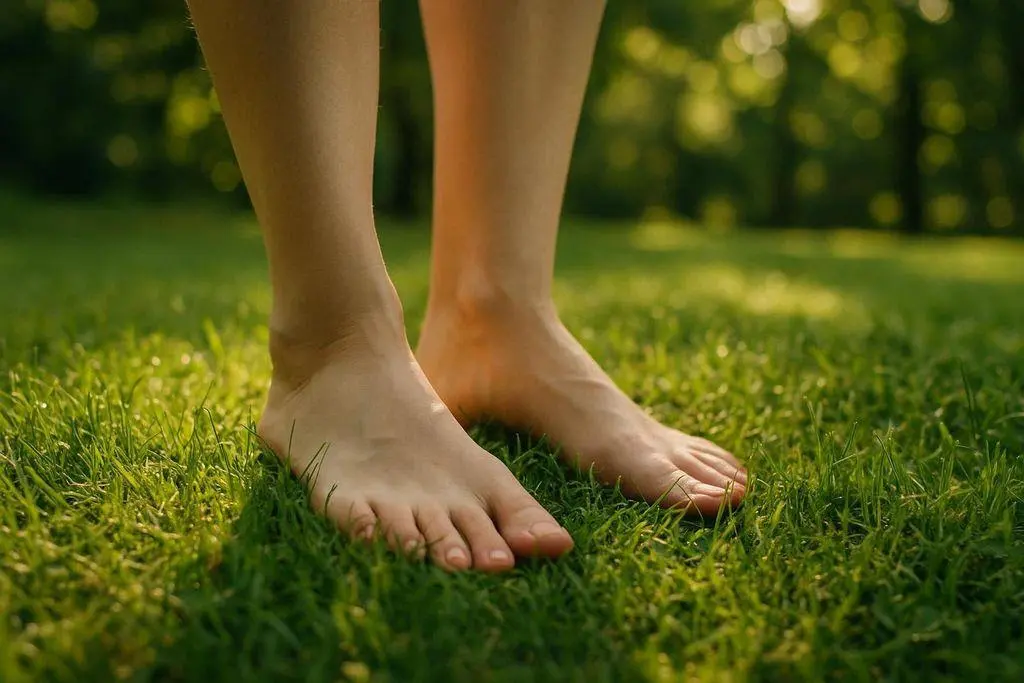
Sit or stand comfortably in a safe outdoor area. Feel the support of the ground and notice your breathing. You may practice barefoot where conditions are safe, but barefoot contact with Earth has not been established as a medical treatment.
Mindful nature walking
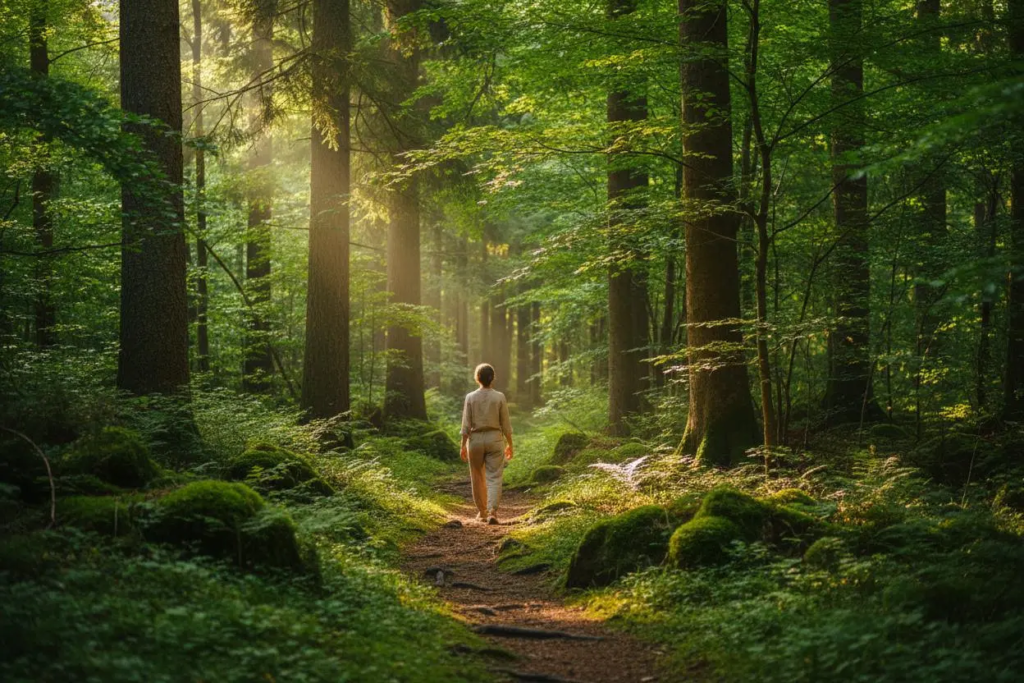
Walk without rushing. Observe colors, textures, sounds, and movement. Give your attention a break from screens.
Outdoor reflection
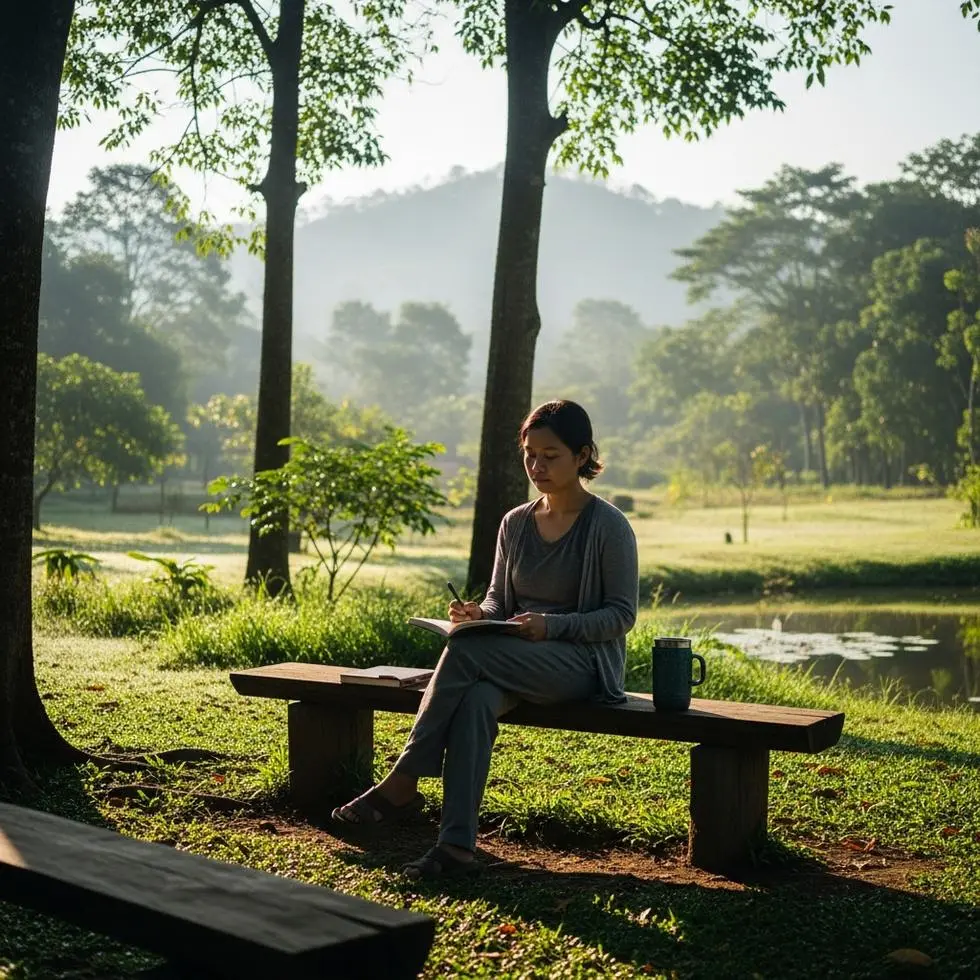
Sit in a garden or park with a journal. Write about your emotions, intentions, or something you appreciate.
Nature-inspired meditation
Focus gently on a natural sound, such as moving water, birdsong, or rustling leaves. Return your attention whenever your mind wanders.
Everyday connection
Care for plants, observe the sky, or spend time in a shaded outdoor space. Choose accessible practices that fit your environment and physical abilities.
The Beyond AI Space approach: Nature as part of conscious living
At Beyond AI Space, nature connection is more than an occasional outdoor activity. It is an invitation to become more aware of how we live, think, and respond to the world around us.
Our approach brings together traditional contemplative practices, mindfulness, personal reflection, and modern knowledge.
We encourage individuals to begin with small, meaningful changes that fit naturally into everyday life.
Through awareness, alignment, and intentional action, reconnecting with nature can become a regular part of a more balanced and fulfilling lifestyle.
Explore Nature Therapy with Beyond AI Space
A 7-Day Journey to Reconnect with Nature and Yourself
Discover guided mindfulness, nature-based reflection, simple daily rituals, and practical ways to build a more conscious relationship with the natural world.
Live online with Komala Thimmappa · 7-day guided experience
Visit Beyond AI Space to explore our programs.
Frequently asked questions
Research references and further reading
These are the primary studies and institutional reports supporting this article.
| Research | Publication | Link |
|---|
| Nature experience reduces rumination and subgenual prefrontal cortex activation | Bratman et al., 2015, PNAS | Original paper |
| The physiological effects of Shinrin-yoku | Park et al., 2010, Environmental Health and Preventive Medicine | Original paper |
| Spending at least 120 minutes a week in nature is associated with good health and wellbeing | White et al., 2019, Scientific Reports | Original paper |
| Urban Green Spaces and Health | WHO Regional Office for Europe, 2016 | WHO report |
| Urban Green Space Interventions and Health: Review of Impacts and Effectiveness | WHO Regional Office for Europe, 2017 | Evidence review |
Educational disclaimer: This article provides general wellness information and is not medical advice. Research findings vary by study design, population, and setting.